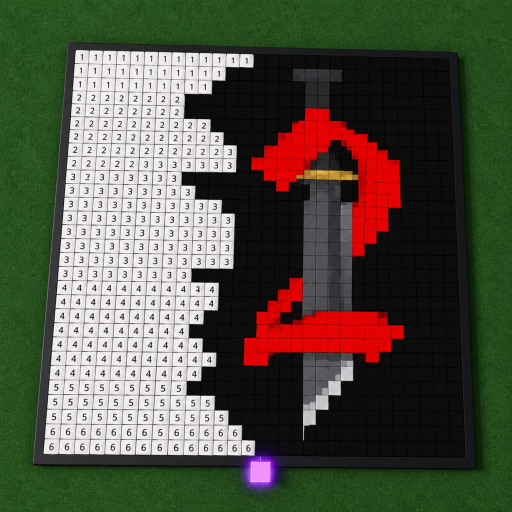
Familiarity
An icon you already recognize paints itself: you know what the next block should be without checking the reference, so misplacements surface immediately. The fan wiki recommends recognizable subjects for exactly this reason.
The game provides no fixed roster or objective icon-difficulty ranking, so this page refuses to invent one. Instead it explains why no tier list can be honest here, and gives you the transparent choice criteria players actually use.
Last updated: 2026-10-03
A tier list ranks comparable things by a measurable standard. Paint a Game offers neither half: its subjects are the icons of other Roblox games, loaded through search rather than drawn from a fixed catalog, and its description attaches no score, rarity, or reward to any of them. The platform checks close the remaining door — with no badges, no game passes, and no currency (2026-10-03), there is no reward gradient for a ranking to predict. Any S/A/B/C table for this game would be fiction wearing a spreadsheet.
What the game does vary is the work itself: icons differ in size, shape count, and color complexity — visibly, not officially. The framework below turns those visible properties into a choice you can defend to yourself, which is what a tier list pretends to do.
Personal planning criteria drawn from the fan wiki's workflow advice and this site's guide experience — not official labels.
An icon you already recognize paints itself: you know what the next block should be without checking the reference, so misplacements surface immediately. The fan wiki recommends recognizable subjects for exactly this reason.
Large visual regions with clean boundaries are simpler to track than many tiny transitions. A logo-like icon with two or three dominant colors reads better across sessions than a detailed screenshot-style icon.
Dense, small-blocked icons are the long-session option. Choose one deliberately, with a region plan and recorded cell counts — the progression guide's checkpoint method exists for projects this size.
In a six-player server your canvas is visible to others. A large, high-contrast subject lets nearby painters recognize the image early — the fan wiki's tip for painting in a shared space.
The standard any future tier list on this site must meet before it replaces this page.
| Requirement | Why it is missing today | Status at 2026-10-03 |
|---|---|---|
| A fixed subject catalog | Icons come from player searches across all of Roblox; the set is open-ended. | Absent |
| Official difficulty data | The description and platform records attach no score to any subject. | Absent |
| A reward gradient | No currency, badges, or completion payouts exist to rank against. | Absent |
| A dated, repeatable method | Any community ranking would need stated criteria and a version to compare against. | None sighted |
Multiplayer is real — a six-player shared painting space, confirmed by the listing and the sampled public servers — but the game describes no classes, roles, synergy, or cooperative scoring. A group plan is social, not tactical: agree on goals and regions, then paint. The session planner exists for exactly that and ranks nothing.
Open friends checklist →Search results mix in a same-title experience by Let's Make More (Universe 10420786315) and other paint-themed Roblox games. Any tier list those pages publish ranks their game's systems, not this painting experience. Check the creator and universe before letting another game's meta choose your canvas here.
There is no objective best icon: the game attaches no difficulty score, rarity, or reward to any subject, so an S-to-C ranking would rank the ranking author's taste, not game data. The choice framework below is the honest substitute — pick by what you can actually evaluate.
No. The official description presents every subject the same way: a Roblox game icon loaded onto a canvas. Platform checks agree there is no reward layer to differentiate them — the badges and game-passes endpoints returned empty at the 2026-10-03 check.
A familiar icon with large, clear shapes: recognition makes mistakes visible, and big regions are easier to track. That is personal planning advice drawn from the fan wiki's workflow tips, not an official difficulty rating.
No reward exists to be better. The economy checks found no currency, no completion payout, and no achievement layer. Paint a harder icon for the challenge itself; the reward is the finished painting.
Only if the game gains something rankable: official difficulty data, or a stable, documented icon catalog with measurable properties. If that happens, the list would arrive with its criteria and checked date stated — never as an invented ranking.